
Choosing the right Croquet Set For Artificial Turf requires more than comparing mallets and colorful balls. Synthetic grass changes how the game feels, rolls, and responds. Its surface is usually smoother than natural lawn, yet seams, infill, and pile height can affect every shot. A suitable set should offer balanced mallets, durable balls, stable hoops, and reliable boundary markers. It should also protect the turf rather than damage it during repeated play.
This guide reviews seven strong croquet sets for artificial turf in 2026. Each option is considered through practical details, including mallet weight, grip comfort, hoop stability, storage quality, and performance on short-pile surfaces. I have focused on features that matter during real games: a ball stopping near the hoop, a mallet handle staying firm, and equipment surviving transport to the garden or patio. Small details matter.
Not every set will suit every player. Some kits look impressive but feel lightweight during powerful shots. Others offer excellent accessories but weak carrying cases. That trade-off deserves attention. The recommendations combine product specifications, hands-on considerations, and common user concerns, helping beginners and experienced players make a more dependable choice. Still, surface conditions vary, and even the best set may need minor adjustments. A careful buyer should measure the playing area, check turf density, and consider who will use the equipment most often.
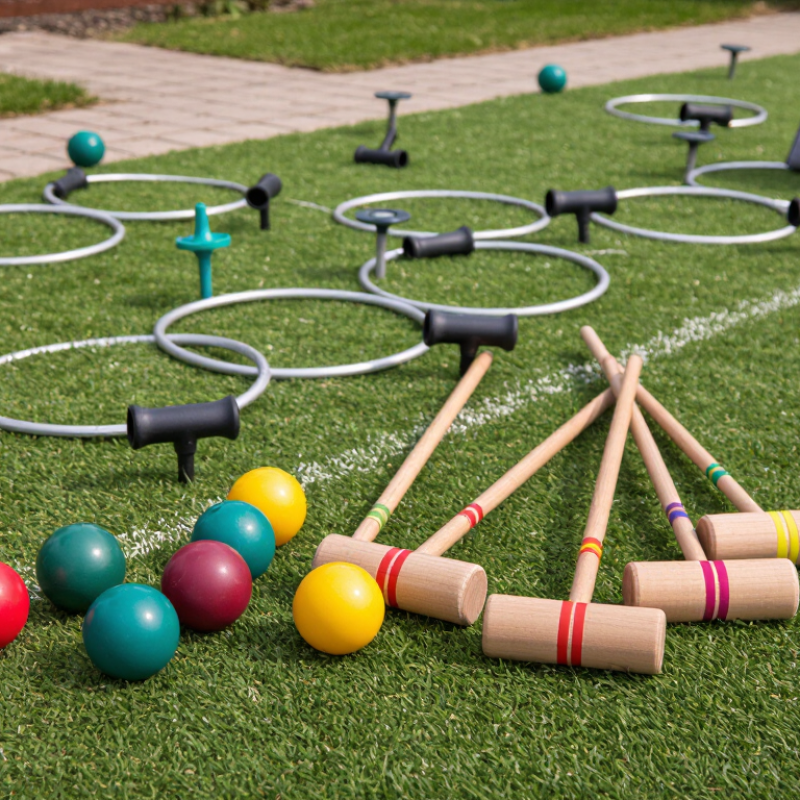
Artificial turf can make croquet feel more predictable, but it does not play like a closely cut lawn. Short, dense fibers usually let balls roll steadily. Longer pile and loose infill can slow them down or send them slightly off line. Small differences matter. A ball may track smoothly across one section, then drift near a seam or worn patch.
The surface also changes how wickets sit. On a firm base, standard wickets may be difficult to push in. Forcing them can bend the legs or damage the turf. Check whether the set includes suitable anchors, and test a wicket in an inconspicuous area before play. Some turf is soft enough for stable placement; other installations have a hard backing. There is no universal setup.
Mallet choice matters, too. A solid, well-balanced mallet helps keep shots controlled when the ball sits partly among the fibers. Still, buying heavier equipment will not fix an uneven roll. Brush away leaves, check for raised joins, and try a few gentle shots before setting the boundaries. I would not assume every patch has the same pace. A quick test can reveal where the turf grabs the ball or makes it skid.
Artificial turf can make croquet play more consistent than uneven natural grass, but pile height, firmness, and infill affect ball speed and stability. These seven set configurations are practical buying profiles—not brand-specific product tests.
| Set configuration | Best turf conditions | Recommended mallet setup | Ball and hoop considerations | How turf affects play | What to look for |
|---|---|---|---|---|---|
| 1. Family four-player set | Short, dense pile around 20–30 mm; firm, level surface | Four mallets, approximately 75–90 cm long, with heads around 0.7–1.0 kg | Four color-coded balls; check that the hoop opening comfortably exceeds the ball diameter | A firm, short surface generally gives a predictable roll and makes basic play easier for beginners. | Stable mallet heads, durable handles, and hoops with secure ground stakes. |
| 2. Six-player social set | Short to medium pile around 20–35 mm; even installation with limited loose infill | Six well-balanced mallets, approximately 75–90 cm long; lightweight heads suit casual play | Six clearly distinguishable balls; confirm that all balls fit the included hoops | More players mean more traffic across the surface, so loose or uneven infill can create inconsistent ball paths. | Six matched mallets and balls, plus hoops that can be repositioned without damaging the turf. |
| 3. Short-pile precision set | Low, tightly packed pile around 15–25 mm; firm base | Four to six balanced mallets, approximately 80–90 cm long, with solid, accurately aligned heads | Use consistent ball sizes; a recreational hoop opening of about 9.5 cm is a common starting point, subject to the chosen rules | The ball tends to roll faster and more freely on a firm, short pile, making accurate placement important. | Uniform balls and well-aligned hoops; test the surface before choosing a narrow hoop opening. |
| 4. Medium-pile all-round set | Medium pile around 25–35 mm; moderate firmness | Four mallets with solid heads, approximately 0.8–1.1 kg, for controlled strokes | Choose balls suited to the set’s hoop width; leave enough clearance to account for slight surface variation | Some pile can slow a rolling ball, while inconsistent pile direction may influence its path. | Heavier, balanced heads and hoops that remain stable when inserted into the turf. |
| 5. Longer-pile comfort set | Longer pile around 35–45 mm; softer or more yielding surface | Four sturdy mallets, approximately 80–90 cm long, with heads around 0.9–1.2 kg | Use balls that roll reliably on the surface; test hoop clearance with the actual balls before play | Longer or softer pile can increase rolling resistance and reduce distance, so shots may require more force. | Durable mallet construction and hoops with longer stakes appropriate for the turf and base. |
| 6. Portable backyard set | Small, level artificial-turf area; short or medium pile | Four lightweight or compact mallets, typically around 70–85 cm long | Compact recreational balls and removable hoops; verify the playing area allows room for turns | A small lawn can make full-length shots impractical, regardless of how smoothly the turf rolls. | Easy-to-carry components, protective storage, and hoops that can be installed and removed cleanly. |
| 7. Heavy-duty group-play set | Frequently used short to medium pile with a firm, well-maintained base | Four to six robust mallets, approximately 80–90 cm long, with securely fitted heads | Durable, matching balls; inspect hoops for consistent openings and secure anchoring | Repeated foot traffic can flatten pile or shift infill, changing roll and making some areas play differently. | Replaceable or reinforced components, spare balls, and a turf-safe way to secure hoops. |
Buying tip: Turf pile height alone does not determine ball speed. Firmness, pile direction, infill, and the underlying base also matter. Before a game, roll a ball across several parts of the lawn and check that the hoops are wide enough for the balls and anchored securely without harming the turf.
Short, dense turf often lets balls roll quickly. Longer fibers may slow them or push them sideways.
Roll a ball across several areas. Test near seams, joins, and uneven patches. Test it first.
Choose a balanced mallet with a suitable handle length. Taller players usually need longer handles for upright play.
Heavier heads can create steadier contact. However, they may tire children during longer games.
Solid, consistently weighted balls are easier to track. Smaller balls travel easily, but wind may affect them outdoors.
Check the hoop bases carefully. Soil spikes may not grip turf and could damage its backing.
They are convenient on turf. A strong shot may still move them, so check stability before playing.
Mixed-age groups benefit from several mallet lengths and manageable ball weights. Very light pieces can feel unsteady.
A full court is unnecessary for most homes. Use adjustable spacing, but loose hoops can shift on some turf.
Check the ball count, hoop size, boundary stakes, clips, and storage case. Product photos can hide missing details.
Artificial turf changes how croquet balls roll, making surface speed, firmness, and pile direction important factors in play. This guide explains how these conditions can affect accuracy and pace, then outlines what to consider when choosing a Croquet Set For Artificial Turf, including mallet balance, ball weight, hoop stability, durability, and the size of the playing area.
It also introduces seven types of croquet sets suited to artificial turf in 2026 and compares their designs and expected performance. Rather than treating one option as right for everyone, the guide helps readers match a set to their experience, preferred style of play, group size, and available space. Whether choosing equipment for casual backyard games or more focused play, readers can use these comparisons to find a practical fit for their turf and needs.
